
Why do you need to load the Data Dictionary into the catalog?
The Data Architect looked at me as if the question made no sense. “I have worked incredibly hard on this. Half a million data assets.” He paused, and I smiled. “But tell me. Why?” The architect had no answer, and his silence said everything.
The Data Dictionary has earned its place on every Data Catalog implementation plan. It makes the catalog feel complete and fills the asset count. Project teams get a metric they can point to: half a million assets cataloged, data governance in motion, and progress is reported on a slide.
For someone in a Data Governance role, watching this unfold, a quiet question never goes away. Why?
What is a Data Dictionary?
A Data Dictionary describes the world inside your database. It captures the structural hierarchy of how data is organized from the database itself, down to the schema, into the tables, and all the way to the individual fields and columns that hold the data.
Connected, the Dictionary Governs
A Data Dictionary on its own is a metadata document. The catalog changes that. It stops being a record and becomes the medium that makes data literate.
Business definitions and calculations link straight to the columns that carry them. Data quality rules run against every critical dataset and stay tied to it. Lineage renders the full path, from provisioning sources through authoritative sources all the way back to the origin, with the guesswork stripped out. Every transformation and derivation along the way is captured. Code lists and reference data trace back to the datasets that put them to use.
Each consumption data source connects to the endpoints that draw on it: reports, models, applications, and external feeds. Inbound and outbound datasets (database tables) carry tags. The catalog audits access, so the most used and most relied-on datasets surface on their own. For every consuming dataset, it records timeliness, so freshness is never a guess.
Security classification reaches the critical dataset and surfaces what is confidential and what is sensitive. Access control runs through the catalog rather than in the shadows. Retention standards decide whether a dataset is held, archived, or disposed of, set by its classification and the rules it must adhere to.
Every critical dataset has an owner and a steward, named and accountable. The data producer and the consumer know each other, and a contract sits between them as the foundation of trust and confidence in data. On-the-fly calculations buried in reports or algorithms are written down, so nothing hides in the logic. Anyone drawing on a non-authoritative source gets a warning. Every exception and concern raised against a dataset is logged and visible to everyone who depends on it.
This is a great and deliberate effort. Fall short of it, and the Data Dictionary slips back to what it began as, a document.
A metadata document, no matter how complete, never governed anything.
Metadata Standards as Guardrails
Left alone, a Data Dictionary drifts back to documentation. Names, descriptions, data types, the bare minimum that feels safe and stays incomplete. Standards change that. They set what metadata must exist before a dataset counts as cataloged or governed, and these metadata standards create the obligation that drives the work. Without them, every team decides for itself what good looks like, and good never looks the same twice.
Build your metadata standards around several traceable catalog components. Each required attribute should support at least one of them. If it supports none, it does not belong.
Several established frameworks offer a starting point. DAMA DMBOK provides the broadest foundation for metadata management practice. ISO 11179 sets the international standard for how metadata registries should be structured. The EDM Council’s DCAM maps metadata maturity directly to business outcomes.
These are complementary lenses. Use them to pressure test your own metadata schema and ask honestly whether what you are capturing is enough to govern, or only enough to document. That is the governance ask.
Without it, you have simply copied the dictionary from its source into the catalog.
Introducing the Dataset Trust Board
Most catalog implementations report the same way. 90,000 tables. 1.2 million columns. A number that looks impressive in a presentation and means very little in a governance conversation.
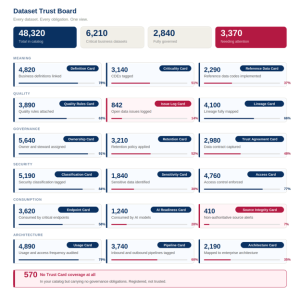
The Dataset Trust Board takes a different approach. Datasets are categorised by their related catalog component across meaning, quality, governance, security, consumption, and architecture. The metrics that emerge go far beyond documentation. They tell you what is governed and what is simply registered.
Each breakdown is a Dataset Trust Card. On one side, what governance obligations have been fulfilled? On the other hand, what remains outstanding? Together, they give leadership something a raw asset count never could: genuine governance insight into the data that drives their business decisions.
Foundation or Building?
A foundation poured is not a building. It is where the building begins.
The Data Dictionary is that foundation. It maps the schema, the tables, and the columns, and gives the catalog something to stand on. Bringing business context to raw data. Attaching meaning, quality, ownership, security, and trust to every dataset the business depends on.
That is when the catalog stops being a register and starts being a data governance instrument. That is when adoption stops being a project metric and starts being a business outcome.
How many of your datasets are foundation layers? How many have become the full-fledged buildings that your business actually relies on?