
The Pursuit of More
Growth is often celebrated as maturity in data governance. The pursuit of more. It is a very human instinct. More feels like progress. More feels like safety. More feels like we are taking the work seriously.
More metadata, more glossary terms, more cataloged assets, more data quality rules. And somewhere along the way the original question gets lost: are we actually making data more useful for the people who depend on it?
Pablo Picasso once said that true art is the ruthless elimination of the unnecessary. I have got into philosophy lately and that line stays with me. Because what we have built in most organizations is the opposite of art.
The Cost of Governing Everything Equally
Governing everything equally has a cost.
When a management reporting system has bad data, every dashboard tells a different story. Leaders stop trusting the numbers. When access to a system holding customer data is not controlled, the risk of a security breach goes up. When a regulatory system is not looked after, fines and consent orders follow.
These are not distant risks. They happen most often in organizations that try to govern everything and end up governing nothing well.
The problem is not that organizations do not care. The problem is that they treat everything as equally important and give everything equal priority.
Essentialism Is Not Doing Less. It Is Doing What Matters.
Greg McKeown, who wrote the book on Essentialism, described it as the disciplined pursuit of less. Not less for the sake of less. Less so that what remains can be done with full focus and full responsibility.
In data governance, which means starting with a simple but uncomfortable question: of everything we are governing right now, what would actually matter if it failed?
The answer to that question is your governance priority. Everything else can wait.
Start Where the Risk Is Highest
Not every system deserves the same governance attention. Some systems are regulatory exposed. Some hold sensitive customer data. Some run on legacy technology where the knowledge of how they work lives with only a handful of people. Some are the authoritative sources for decisions that reach the board.
Those are the systems you govern first. Not because it is easy, but because the cost of not governing them is too high to ignore.
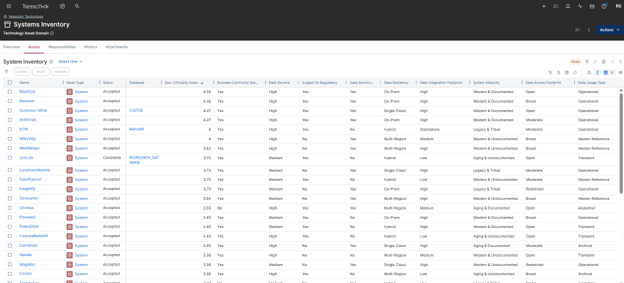
In Collibra, this is exactly what a Systems Inventory with a risk profile looks like. Every system assessed across eleven dimensions tells you where the governance stakes are highest.
ECM: A System That Cannot Wait
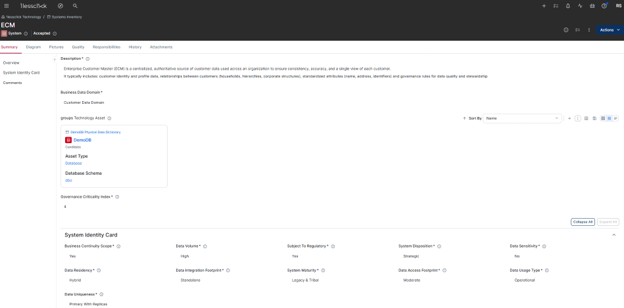
Take ECM as an example. It is a strategic system, operationally critical, carrying high data volume, subject to regulatory requirements, with data spread across hybrid infrastructure. It is the kind of system that boards rely on for decisions and regulators look at during reviews.
And yet its maturity profile tells a different story. Legacy technology. Tribal knowledge. The understanding of how it works and what it holds lives with a handful of people.
That combination is where governance needs to start. Not after everything else is cataloged and documented. Right here, right now.
The screenshot below from the Collibra Catalog illustrates a practical example.
The Discipline to Say No to the Non-Essential
Essentialism in governance takes courage. It means being willing to question what the program has been spending its time on. Are any of those 4,000 glossary terms connected to a real business decision? Are the systems being cataloged actually strategic for the future? Are the meetings producing anything beyond more meetings and minutes that very few people read?
I understand this culture of more is comfortable because it simply generates activity. But activity is not the same as business value.
I have seen governance programs score 90% on completeness and still fail to prevent a regulatory finding. I have seen catalogs with 100,000 assets where only a handful of systems that actually mattered had any priority and attention from their owners and stewards.
Essentialism Is the Foundation
Ludwig Mies van der Rohe, one of the great architects of the last century, said less is more. But in most governance programs we quietly rewrote that to more is more. More assets, more rules, more meetings, more tools. And the more we added, the less value we delivered.
Essentialism is not a framework. It is a mindset. It is the discipline to ask, every single day, whether what we are doing is actually moving the needle for the business.
At 1lessclick, I start every engagement by looking for the essential few. The systems that carry the most risk. The data that drives the most important decisions. The governance that would hurt the most if it failed.
Start there. Do that well. Everything else will follow.