
I walked into the Verizon store in Manhattan and saw the iPhone for the first time. It felt different. My BlackBerry had a key for everything. This one had almost nothing, just a sheet of glass I could touch.
That phone pushed my Canon T3i into a drawer. My shelf of audio and video discs soon felt like a pile no one needed, stacked against a streaming app that simply played. Today billions of us share our lives on platforms like Instagram, in a clip that takes a moment to make.
What do all of these have in common? They did less, and they asked less of us. That is simplicity, and it is what I have come to want from our data governance tools and platforms.
We harvest database objects and system inventories, business glossaries and reference codes, business and technical data quality rules, report catalogs, data processes, transformation rules, and metrics. We profile the sources, capture the lineage, attach the rules, and link the terms. We report hundreds of thousands of assets cataloged, and one of our main success criteria is to grow the sheer volume of assets we bring in.
Then a business or data user opens the catalog, and the experience turns complicated.
Imagine buying a boat and being told to sit through training before you may take it out, one class on the rudder, another on the sails, another on the anchor. That is not a sailing boat. That is a burden.
Here is what I keep seeing in my own work. A data steward opens a task and pauses, unsure what is being asked. A data manager or subject matter expert means to add business context, but it turns into clicking through page after page. A data consumer cannot tell if a dataset is fit for use without talking to someone. The technical lineage diagrams render like a plate of spaghetti, scaring people off. Where did this data originate, where is it mastered, what is its authoritative source, and who owns it? The catalog holds every answer, yet it does not speak. Why?
A data catalog is a central place that organizes metadata so we can discover, understand, and manage our data. That is the promise. Yet we never built the simple part, the part that makes all of it feel easy. The catalog is not easy, and our leaders are raising the alarm about the adoption of the data governance platform.
What if every answer was just one less click away?
As per Market Research Future, the data governance industry is set to grow from 3.566 billion dollars in 2025 to 14.45 billion by 2035, a compound annual growth rate of 15.02 percent. North America remains the largest market, while Asia-Pacific is rising the fastest, pushed by growing data privacy concerns and digital transformation.
Organizations are recognizing that effective data governance does more than reduce risk. It sharpens the decisions leaders make every day. With that has come a clear shift toward newer technologies and methods that streamline how governance is practiced. Data catalogs now fold in machine learning and artificial intelligence to handle the heavy lifting, automating metadata tagging, data classification, and lineage tracking. Thus, the growing adoption of AI and ML is transforming the landscape of this tool.
The next-generation data catalog, powered by machine learning and agentic AI, will also become home to the enterprise’s vast and largely untapped world of unstructured data.
My hope is simple. I want the sophistication to live under the hood, quiet and unseen, so what reaches the user is simplicity itself. The most famous use of one line goes back to 1977, when Apple created a brochure for its new Apple II personal computer that read, simplicity is the ultimate sophistication. I feel like that should be the design principle for these next-generation data catalogs.
Picture Josh Harris from the Sales reporting team. He signs in to the catalog and lands on the home page. He is looking for a dataset, types a few keywords into the search bar, scans the results, and opens the asset page for the one that matches. He reads the business description and the linked glossary terms, so the meaning is clear before he goes further. He checks the data quality scores, accuracy, and timeliness in particular, to judge whether he can trust it. The business lineage diagram shows him the authoritative source, and he is glad to see both the owner and the technical steward already assigned. He opens the privacy section and finds the sensitive fields tagged with their security classification. He notices the Customer Success domain is already using it. In a few quiet minutes, Josh has every answer he came for.
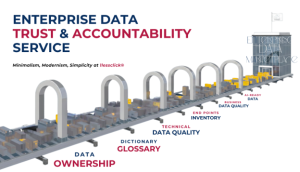
I am often handed the hardest brief in our field, hundreds of source systems, and an enterprise policy-driven mandate to bring the data under governance. I have stopped treating it as a marathon and started running it as one clear chain, where every link pulls the next into place. Here is how.
I start by prioritizing the highest-risk, strategic systems for Enterprise Data Governance, measured by each system’s risk profile. Ownership is then established through the business domain structure, with the business taxonomy consistently standardized across the enterprise. Roles are assigned at the domain and system level, responsibilities are made clear, and formal acknowledgement is captured from owners, stewards, and subject matter experts, system owner and technical manager alike, so accountability is traceable right from the foundation.
From there, the process chain moves to the data itself. Data architects identify the datasets that matter most for a system, documented down to the critical fields. Each dataset gets a manager, the business glossary fills in automatically, and the experts sharpen the definitions. The critical datasets and columns flow into Collibra Data Quality, where you can easily create rules and measure quality against technical dimensions. The metrics are integrated and reported to the catalog. Privacy is captured along the way, so nothing sensitive travels unseen.
Once the system’s metadata passes through these checkpoints, the business folks are engaged to confirm and manage the critical endpoint inventory. More quality rules come online, monitoring business accuracy and timeliness. Every data exception and concern is logged, assigned, prioritized, remediated, and closed, so nothing is left to drift. Newer demands, like AI-ready data, are met the same way, through a checkpoint of their own. All of it is done through simplicity born of sophistication, the one less click experience.
For me, simplicity is part of who I am. I design frameworks and solutions to be usable, accessible, and elegant. True simplicity feels like a natural extension of the person using it, effortless on the outside, sophisticated underneath.
Data Governance will always have many moving parts. Our job is not to infuse complexity, but to perfect the process. Every click removed is a step toward a relentless pursuit of simplicity.